
 Written by Rick Hummell, Communications Specialist
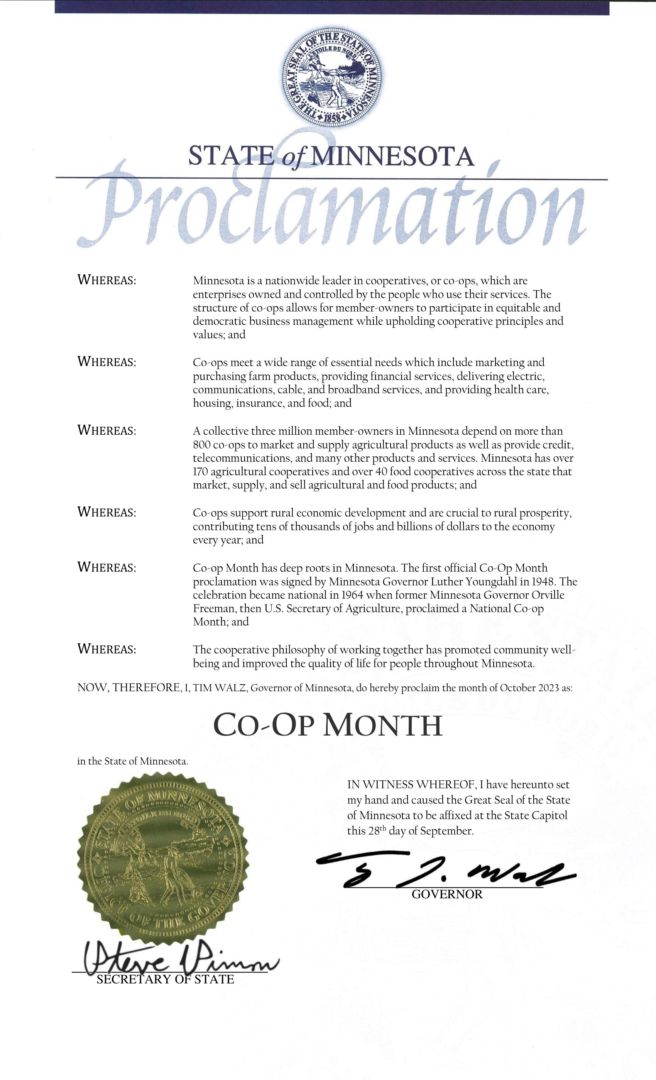
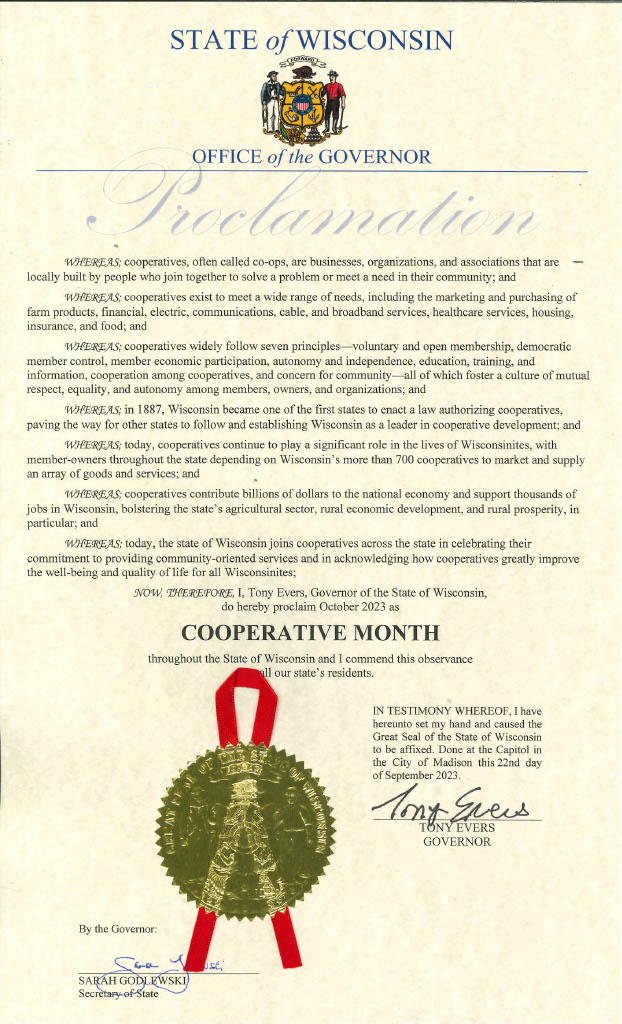
Responding to requests from Cooperative Network, Wisconsin Gov. Tony Evers and Minnesota Gov. Tim Walz recently signed proclamations declaring October as ‘Co-op Month’ in their respective states.
During Co-op Month, cooperatives celebrate the cooperative movement and the role cooperatives play in achieving economic viability and contributing significant social benefits in the communities in which they operate.
“Cooperative Network joins the greater cooperative community in recognizing October as Co-op Month, an annual recognition in which cooperatives and their members make a special effort to educate the public about their member-owned and member-controlled business form,” said Cooperative Network President and CEO Dan Smith. “Minnesota and Wisconsin have proud cooperative heritages, and we greatly appreciate the governors of both states signing proclamations recognizing the major impacts cooperative businesses have in their states.”
Smith said this year’s Co-op Month theme, “Owning Our Identity,” provides an opportunity to reflect on what makes cooperative businesses unique in the marketplace. Guided by a set of shared principles and values – among them democracy, equity and solidarity – co-ops are hardwired for economic and societal transformation. In a moment when corporations are scrambling to find an identity outside of maximizing shareholder value, that’s a meaningful difference, said Smith.
Minnesota is home to about 1,000 cooperatives; Wisconsin about 800. Between them, the two states have the highest concentation of cooperatives in the nation. Cooperative Network works on behalf of cooperatives large and small from a dozen business sectors, all of which play an essential role in the economic well-being of each state. These sectors produce goods and services through farm production, farm supply, grain marketing, ethanol production, dairy marketing and processing, financial services, livestock genetics, meat processing, mutual insurance, telecommunications, electrical power and distribution, and other services.
A cooperative is defined as an “an autonomous association of persons united voluntarily to meet their common economic, social and cultural needs and aspirations through a jointly-owned and democratically-controlled enterprise.” This mean co-ops are governed by their members, the everyday people who use the business, as opposed to investors or shareholders. Members may be consumers, workers, producers, or independent business owners who govern the co-op on a democratic basis.
This unique relationship is recognized in international law, as well as by the U.S. Department of Agriculture, which affirms that co-ops are “user-owned businesses that are controlled by – and operate for the benefit of – their members, rather than outside investors.”
44 East Mifflin Street, Suite 801 Madison, WI 53703
Phone: 608.258.4400